Redefining Logistics with Autonomous Cargo Drones
In the evolving landscape of defense and commercial logistics, where speed, efficiency, and cost-effectiveness are paramount, Skyways is emerging as a critical innovator. This Austin, Texas-based company is not just building drones; it is forging a new paradigm for long-range, autonomous cargo transportation, aiming to create the world’s largest fleet of unmanned logistics aircraft. Their story is one of ambitious vision, rapid prototyping, and strategic partnerships, all geared towards delivering essential supplies to challenging environments, from remote military outposts to offshore platforms.
From Traffic Frustration to Airborne Solutions
The genesis of Skyways traces back to 2017, born from the personal frustration of co-founder and CEO Charles Acknin with the pervasive traffic congestion in Silicon Valley. Recognizing the burgeoning growth in unmanned aviation and concurrent advancements in energy storage and electric propulsion, Acknin and his team saw an opportunity to create a novel form of transportation – one that could bypass ground-based limitations. As noted by sUAS News, this insight led to their participation in Y Combinator in the summer of 2017, marking the official start of their journey to revolutionize cargo delivery.
From its inception, Skyways has adopted a distinctive development philosophy. Unlike many companies that spend prolonged periods in theoretical development or slide-deck presentations, Skyways prioritizes building and flying full-scale aircraft early in the development cycle. Charles Acknin, as quoted in Dronelife on June 9, 2025, stated, “Our approach is different from most companies as we self-fund building and flying full-scale aircraft early during development so prospective customers can see real capability, not a slide deck. We’ve figured out a way to do it rapidly and at low cost.” This hands-on, rapid prototyping approach has been instrumental in securing key contracts and demonstrating tangible capabilities to potential clients.
A Growing Fleet: V2 to the Next-Generation V3
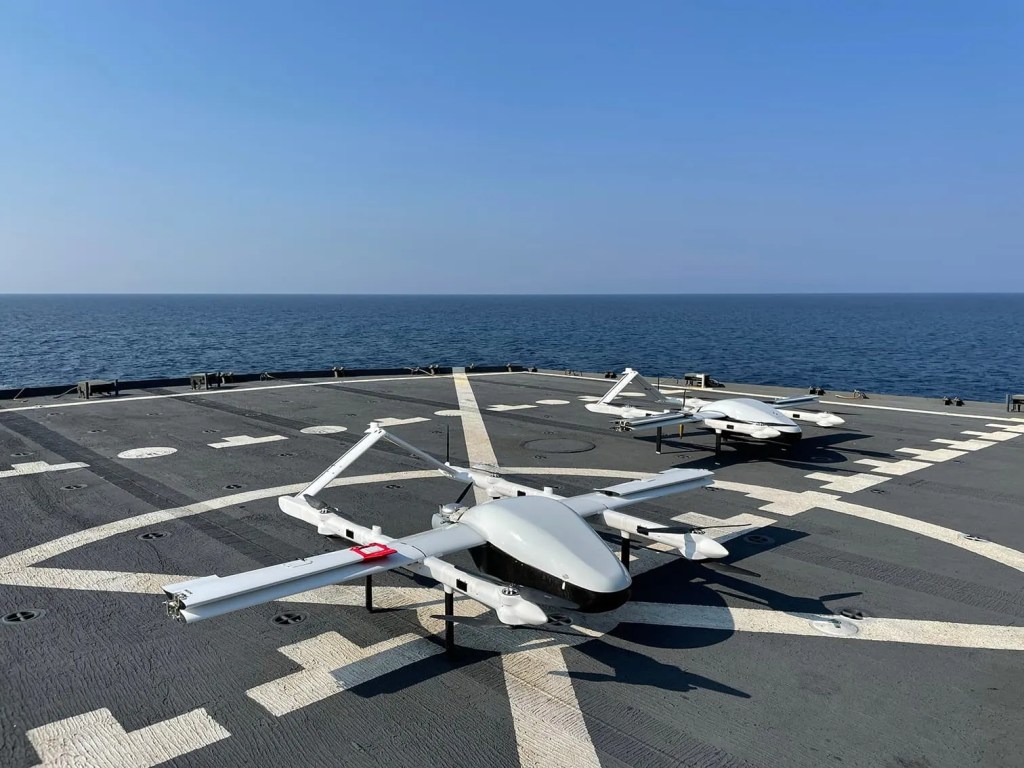
Skyways has developed a series of autonomous unmanned aerial vehicles (UAVs) designed for long-range cargo missions, with their aircraft already operational and serving both military and commercial clients.
- Skyways V2: This model is currently flying long-range logistics missions. The V2 drone is capable of carrying up to 30 lbs of cargo and has a maximum range of 500 miles. It has been tested in various demanding conditions, demonstrating its reliability in real-world scenarios.
- Skyways V3: Building upon the success of the V2, the V3 is Skyways’ next-generation platform. It leverages the same proven autonomy software but with significantly enhanced performance. The V3 is designed to carry a useful load of 100 lbs, boasts a maximum range of over 1,000 miles, and can remain airborne for more than 20 hours. Both the V2 and V3 platforms feature a “double-hybrid” design, allowing them to take off vertically like a helicopter and transition to efficient forward flight like a plane, utilizing both electric and fuel-based energy. This dual-mode propulsion provides operational flexibility and extended range, critical for diverse mission requirements. As reported by HeliHub.com on June 10, 2025, the V3 aims for mass manufacturing, with a target to deploy thousands of units for both defense and commercial applications.

These aircraft are not just technical marvels; they are built for scale and cost-efficiency. Skyways envisions its uncrewed aircraft as a new class of cargo transport optimized for mass production, capable of supporting logistics operations in areas where conventional aviation is too expensive, dangerous, or impractical. This includes resupplying remote operations with vital supplies like MREs, batteries, and medical provisions, flying over challenging terrain and hazards without risking human lives, and providing on-demand resupply capabilities for offshore platforms.
Strategic Partnerships and Significant Milestones
Skyways’ ambition is backed by crucial partnerships and significant financial support, particularly from the U.S. defense sector.
- U.S. Air Force AFWERX Contract: A major milestone for Skyways came with the announcement on June 9, 2025, of a $37 million contract award from the U.S. Air Force’s innovation unit, AFWERX. This substantial funding is specifically allocated to transition Skyways’ V3 cargo drone from prototype to full-rate production. The contract will enable Skyways to complete its production design, further enhance its autonomy stack, and prepare for large-scale manufacturing. As stated by Business Wire on June 9, 2025, this initiative aims to establish Skyways’ platform as a “Program of Record” for unmanned aerial logistics within the USAF, signifying a critical step towards broad adoption in defense operations. AFWERX, a directorate of the Air Force Research Laboratory (AFRL), plays a vital role in integrating cutting-edge technologies from small businesses and startups into defense operations.
- Orbital UAV: In October 2021, Skyways signed a Memorandum of Understanding (MoU) with Orbital Corporation Ltd (Orbital UAV) to support Skyways’ unmanned cargo transportation program for the US Navy. This partnership focuses on developing propulsion systems that enhance the performance and reliability of Skyways’ UAVs, further solidifying their capabilities for naval applications.
- US Navy Prototypes: Skyways has also been engaged in projects with the U.S. Navy to develop prototypes for long-range ship-to-ship and ship-to-shore cargo transport. This demonstrates the critical applicability of their UAVs in military logistics, particularly in maritime environments where traditional supply chains can be challenging and costly.
The focus on defense applications is clear: Skyways’ aircraft are designed to provide rapid, cost-effective, and safe logistics solutions in contested environments, reducing the reliance on crewed aircraft and mitigating risks to personnel.
The Future: A Global Fleet of Autonomous Logistics
Skyways’ vision extends far beyond current capabilities. Their audacious goal for the next five years is to build the world’s largest fleet of autonomous logistics aircraft. This ambition is underpinned by their strategy of pairing flight-proven autonomy with designs optimized for mass production, enabling highly scalable and cost-effective logistics.
The potential applications of Skyways’ technology are vast, extending across various critical sectors:
- Military and Defense: Their core focus includes tactical resupply, medical logistics, and enhanced situational awareness in combat zones. The ability to deliver supplies without risking human lives or requiring complex ground infrastructure is a game-changer for military operations.
- Oil and Gas: Autonomous cargo drones can revolutionize logistics for offshore oil and gas platforms, providing on-demand resupply and reducing the need for costly and often hazardous helicopter or boat transport.
- Emergency Response and Disaster Relief: In situations where traditional infrastructure is damaged or inaccessible, Skyways’ drones can deliver life-saving medical supplies, food, and equipment to remote or affected areas quickly and efficiently.
- Commercial Logistics: Beyond defense, the commercial applications are immense, including last-mile delivery to remote communities, agricultural support, and critical component transport for industrial operations. The company envisions future applications even extending to passenger transport, though their immediate focus remains on cargo.
Skyways distinguishes itself by its deep expertise in autonomous UAV development, combining vertical takeoff and landing (VTOL) capabilities with advanced AI and machine learning algorithms for navigation, obstacle avoidance, and mission planning. Their emphasis on “embodied AI” ensures that their UAVs can operate efficiently and safely even in complex and dynamic scenarios.
As the world increasingly recognizes the strategic importance of unmanned systems and resilient logistics, Skyways is positioning itself as a pivotal force. By continuing to innovate and scale its production, Skyways is not only building a successful business but also shaping the future of global logistics, making it faster, safer, and more accessible for critical missions both in defense and beyond.