Charting a Course for the Future of Space and Hypersonic Flight
In the dynamic and often secretive world of aerospace and defense, a German startup named Polaris Spaceplanes is making significant waves. Born from decades of meticulous research at the German Aerospace Center (DLR), Polaris is not just building rockets; they are forging a new paradigm for access to space and high-speed flight with their revolutionary “spaceplane” technology. Their vision is clear: to deliver routine, low-cost, and safe access to space, fundamentally altering how we perceive and utilize the orbital frontier and hypersonic capabilities.
From DLR Research to Commercial Ambition
The story of Polaris Spaceplanes begins with a rich legacy of German and European spaceplane research. For over 30 years, engineers and scientists at institutions like the DLR meticulously explored concepts for reusable launch vehicles that could combine the best attributes of both aircraft and rockets. This deep-seated expertise formed the bedrock upon which Polaris Raumflugzeuge GmbH was founded in 2019 by Dr. Alexander Kopp. The goal was to take this cutting-edge research out of the laboratories and into a commercial reality, developing a multipurpose spaceplane and hypersonic transport system known as Aurora.
Traditional space transportation relies heavily on vertically launched, expendable rockets, which, while effective, are inherently costly and require extensive infrastructure. Polaris recognized the transformative potential of reusable, horizontally-launched “spaceplanes.” Such vehicles, capable of taking off and landing like conventional aircraft from standard airports, eliminate the need for complex and expensive launch pads, promising significant cost savings, enhanced flexibility, and improved safety. Early studies, such as the European Space Agency’s FESTIP (Future European Space Transportation Investigations Programme), had already identified these types of vehicles as the most economically viable solution for future spaceflight. Polaris was founded to bring this vision to fruition.
The Aurora Concept: A Blend of Air and Space
At the heart of Polaris’s innovation is the Aurora spaceplane. This ambitious project aims to create a hybrid aircraft-rocket vehicle capable of delivering payloads up to 1,000 kilograms to low Earth orbit. The Aurora system is designed to be a two-stage, fully reusable vehicle, although Polaris’s roadmap includes a “semi-SSTO” (Single-Stage-To-Orbit) or “1.5-stage” concept initially, with the long-term goal of evolving into a full SSTO as technology matures.
The technology underpinning Aurora is a sophisticated fusion of aerospace engineering principles. For takeoff, cruise, and landing, the spaceplane will utilize conventional jet engines. However, for the crucial ascent into space and hypersonic flight, it will rely on an in-house developed aerospike rocket engine.
The Aerospike Advantage: A Game-Changer in Propulsion
The aerospike engine is a critical component of Polaris’s strategy. Unlike traditional bell-shaped rocket nozzles, an aerospike engine uses an inverted bell or a central spike, allowing it to adapt more efficiently to changes in atmospheric pressure at different altitudes. This adaptability translates to higher efficiency and power across a wider range of flight conditions, from sea level to the vacuum of space.
While the concept of aerospike engines dates back to the 1950s, practical implementation has been hindered by significant engineering challenges, primarily related to cooling and structural complexity. Polaris has tackled these hurdles head-on, focusing on advanced cooling technologies and novel materials to make the aerospike a viable solution.
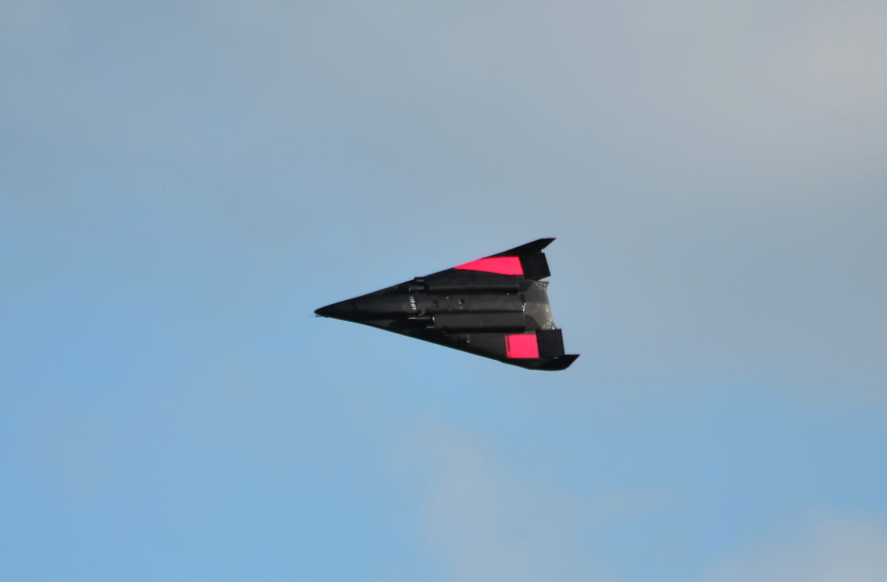
Their dedication has yielded impressive results. In October 2024, Polaris made history by conducting the first-ever flight powered by an aerospike engine. Aboard their MIRA-II demonstrator, the AS-1 engine was successfully ignited in flight over the Baltic Sea, running for three seconds and delivering 900 Newtons of thrust, accelerating the 229kg vehicle to 864 km/h. This groundbreaking achievement validated a core technology crucial for the Aurora. Further flight testing of the AS-1 is planned throughout 2025.
Flight Demonstrators: Proving the Concept Step-by-Step
Polaris’s development strategy is a methodical one, centered on building and testing progressively larger demonstrators to validate key technologies and operational concepts. This iterative approach allows them to learn and refine their designs at each stage, mitigating risks and accelerating progress.
Their journey with demonstrators has seen both challenges and triumphs:
- Mira I: The first demonstrator, Mira I, provided valuable early data but unfortunately crashed shortly after its inaugural flight. This setback, common in pioneering aerospace endeavors, provided crucial lessons that were immediately integrated into subsequent designs.
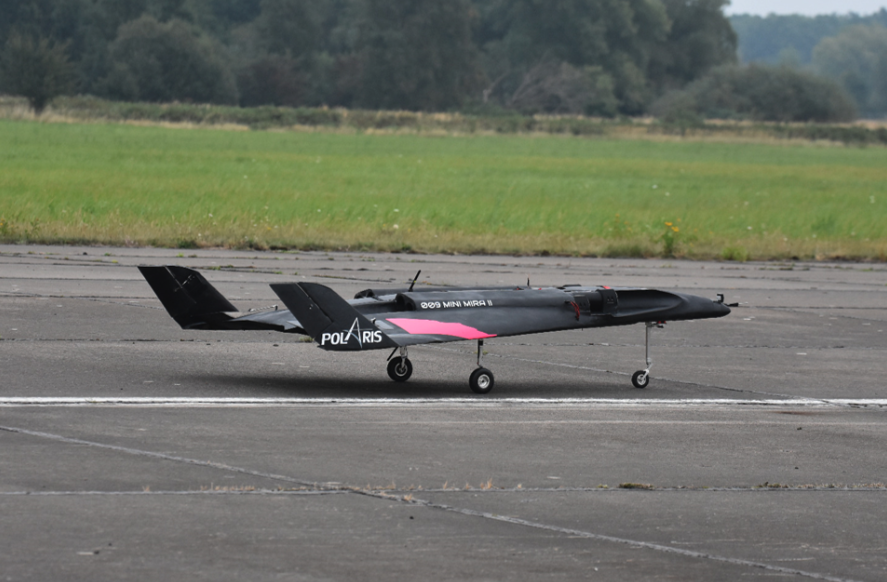
- Mini MIRA II: This smaller demonstrator completed a total of 26 test flights in late 2023, serving as a vital platform for early validation of systems and flight characteristics.
- MIRA II and MIRA III: These are the company’s current workhorses. Each of these identical 5-meter-long vehicles weighs around 240kg and is equipped with both jet turbines for atmospheric flight and the AS-1 aerospike rocket engine for high-speed propulsion tests. Since their launch in September 2024, MIRA II and MIRA III have collectively completed over 100 successful test flights, meticulously collecting data and demonstrating the stability and performance of the integrated systems.
- NOVA: Building on the success of the MIRA series, Polaris is progressing towards the seven- to eight-meter NOVA demonstrator, with its first flight expected by the end of 2025. This larger vehicle will further validate the scaling of their technologies.
- ATHENA: Developed under a contract from the Bundeswehr (German Armed Forces) awarded in March 2022, the ATHENA spaceplane demonstrator successfully completed its first flight from Peenemünde airport in November 2024. This demonstrator is specifically designed for military applications, highlighting Polaris’s growing involvement in the defense sector.

Strategic Funding and Key Partnerships
Polaris Spaceplanes has attracted significant interest and investment, underscoring the confidence in their technological approach. They have secured a total of €12.4 million in funding, including a recent €5.4 million top-up to their seed round in June 2025, co-led by Capnamic Ventures Bremen and Spacewalk VC, with contributions from Dienes Holding and E2MC Ventures. This funding is crucial for bringing their first commercial product to market, fulfilling existing customer contracts, and preparing for a larger funding round in the near future.
Beyond financial backing, Polaris has forged critical partnerships:
- German Aerospace Center (DLR): A cooperation agreement signed in July 2024 focuses on joint research activities for airspace integration and flight operations of spaceplanes and hypersonic vehicles, leveraging DLR’s extensive expertise.
- Bundeswehr (German Armed Forces): The German Ministry of Defence has been a key supporter, awarding Polaris multiple contracts. In July 2021, Polaris received its first Bundeswehr contract to investigate the Aurora spaceplane’s application for reconnaissance missions (Project RDRS). In March 2022, a contract was awarded to build and flight-test a scaled demonstrator (ATHENA). Most recently, in February 2025, the German government awarded Polaris a contract to design a reusable hypersonic vehicle for testing hypersonic weapons and transporting satellites. This contract also includes follow-on options for manufacturing and flight-testing of the full-size vehicle.
- NATO Hypersonics Working Group: Polaris joined NATO’s Science and Technology Organization (NATO STO) Hypersonics Working Group in April 2022, where they lead activities on the newly created topic of “hypersonic aircraft,” further solidifying their role in defense innovation.
- Diehl Defence: A landmark strategic partnership was announced at the Paris Air Show in June 2025 with Diehl Defence, a major German defense contractor. This exclusive agreement aims to develop a new airborne defense capability under the “Airborne Launching and Attack System (AirLAS)” program. The collaboration will integrate Polaris’s unmanned aerial carrier systems with Diehl Defence’s combat-proven IRIS-T air-to-air guided missiles. Initial flight tests of this integrated system are scheduled for later this year. This signifies a significant leap for Polaris into active defense applications.
Applications: Beyond Launch into Defense and Beyond
The applications for Polaris’s spaceplane technology are diverse and far-reaching, spanning both commercial and defense sectors:
Commercial Applications:
- Satellite Launch: The Aurora, with an expendable upper stage, can serve as a highly flexible and cost-effective small-satellite launcher, addressing the growing demand for rapid deployment of constellations.
- Hypersonic Transport: The ability to travel at speeds exceeding Mach 5 opens up possibilities for ultra-fast point-to-point transportation of critical cargo, and eventually, even passengers, dramatically reducing travel times across continents.
- Space Tourism and Research: While long-term goals, the path to routine, affordable access to space lays the groundwork for future space tourism and enables more frequent and accessible scientific research missions.
Defense Applications:
- Hypersonic Testbed: The reusable hypersonic vehicle being developed for the Bundeswehr will serve as a crucial testbed for hypersonic weapons and scientific research, enabling Germany to stay at the forefront of this critical technological domain.
- Reconnaissance: The Aurora spaceplane’s ability to operate both within and outside the atmosphere makes it a compelling platform for rapid, high-altitude reconnaissance missions, offering strategic advantages in intelligence gathering.
- Tactical Response: The AirLAS system developed with Diehl Defence represents a revolutionary approach to air defense. By combining reusable, autonomous carrier platforms with IRIS-T missiles, it offers extended range, enhanced operational flexibility, and rapid deployment capabilities. This system could provide layered defense against a spectrum of aerial threats, from UAV swarms to advanced missile systems, and has potential for integration into future combat air systems like FCAS (Future Combat Air System) and maritime operations.
- Distributed Logistics: In a military context, the ability to launch and land from diverse locations, bypassing traditional airport infrastructure, offers immense advantages for resupplying widely dispersed forces or conducting operations in austere environments.
The Road Ahead: Ambition and Innovation
Polaris Spaceplanes is on an ambitious trajectory. Their roadmap targets a light spaceplane (like Aurora) to be operational by 2027, with a heavy vehicle following in the early 2030s. The heavy spaceplane, while initially a “semi-SSTO” concept, aims to evolve into a fully reusable orbital spaceplane, potentially offering an order of magnitude reduction in launch costs compared to conventional rockets. This heavier vehicle could transport passengers and astronauts to space stations and back, launch larger satellites, and even facilitate missions to the Moon and beyond with an upper stage.
The company’s continuous investment in advanced technologies, such as in-flight refueling capabilities (with initial flight experiments in 2024 and docking experiments planned for early May 2025), demonstrates their commitment to pushing the boundaries of what’s possible in aerospace.
Polaris Spaceplanes represents a compelling fusion of German engineering prowess, entrepreneurial vision, and a deep understanding of the evolving needs of both commercial and defense sectors. Their unwavering focus on reusability, efficiency, and flexibility positions them as a key player in shaping the future of space access and hypersonic flight. As their demonstrators continue to fly and their partnerships deepen, the story of Polaris is a testament to the power of innovation in unlocking new frontiers.