The Digital God of Order in an Age of Drone-Driven Chaos
In the ancient world, when chaos threatened to consume all, the Babylonians told a story of a young god, Marduk, who rose to defeat the primordial monster Tiamat and bring order to the heavens and the earth. He was a protector, a creator of order from chaos. Millennia later, in the digital forge of Estonia, a nation renowned for its technological prowess, a new entity has claimed this ancient mantle. This is the story of Marduk Technologies, a startup that is not battling mythical beasts, but a very modern and increasingly chaotic threat: the malicious drone.
The skies of the 21st century are no longer the exclusive domain of multi-million-dollar aircraft. They are buzzing with a new kind of aerial vehicle: small, agile, and often commercially available drones. While these unmanned aerial vehicles (UAVs) offer incredible benefits in logistics, photography, and countless other industries, they have also cast a long and ominous shadow over the worlds of defense and security. In the hands of nefarious actors, a simple quadcopter bought online can become a tool for surveillance, disruption, or even attack.
This new reality became starkly clear as conflicts evolved in the last decade. Off-the-shelf drones, modified and weaponized, began to play a pivotal role on the battlefield, while also posing a significant threat to critical infrastructure, from airports to power plants. The problem was compounded by a dangerous evolution in drone technology. As Martin Simon, the CEO of Marduk Technologies, explains, “Drones have reached level 4 autonomous capabilities, meaning they can be thrown into uncharted territory and operate autonomously – without GPS, 4G or human piloting.”
This autonomy renders many traditional countermeasures obsolete. Systems that rely on jamming the radio frequencies between a drone and its operator are left helpless against a machine that flies a pre-programmed route in total radio silence. A new kind of guardian was needed—one that could see, think, and act against this new breed of silent, autonomous threats. It was to answer this critical need that Marduk Technologies was founded in Tallinn in 2016.
The Modern-Day Marduks and Their Mission
The choice of name was no accident. The founders saw a direct parallel between the mythological god and their own mission. As they stated, “The founders of Marduk Technologies picked the name because they see themselves as the modern-day marduks – slaying drones, and often in the same region where the mythological Marduk did.” This wasn’t mere branding; it was a statement of intent. Their goal was to bring order to the increasingly chaotic and contested airspace of the modern world, to become the ultimate slayer of bad drones.
From its inception, Marduk set its sights on a formidable technical challenge: to detect and neutralize drones without making a sound. The key was to develop a passive system, one that doesn’t emit its own signals, like radar, which can be detected and targeted by an enemy. Their solution lay in harnessing the power of electro-optical (EO) and infrared (IR) sensors, essentially creating a highly advanced set of digital eyes.
But simply seeing a drone isn’t enough. The sky is full of objects—birds, balloons, and other clutter. The true magic behind Marduk’s technology is its brain: a sophisticated suite of patent-pending artificial intelligence and machine learning algorithms. This AI is trained to do what no human operator could: relentlessly scan the sky, differentiate the unique flight patterns and thermal signatures of a drone from a bird, classify the specific type of UAV, and lock onto it with unerring precision. This entire process, from detection to targeting, happens in the blink of an eye.
The Shark and the Piraya: Tools of a Digital God
The culmination of this effort is the company’s flagship product: the Marduk Shark. This formidable platform is a multi-layered, modular system designed for high-precision detection, recognition, and targeting of small to medium-sized drones. With a gimbal that can whip around at up to 270 degrees per second, the Shark can track even the most agile targets. It can spot a small DJI Mavic-sized drone from up to 3 kilometers away and larger, military-grade drones like the Shahed or Orlan from distances of 6-8 kilometers.
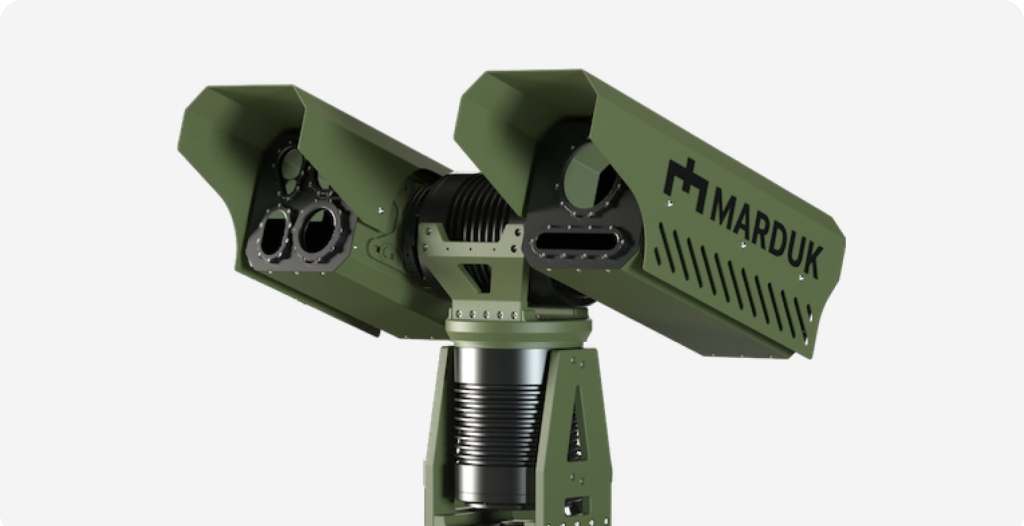
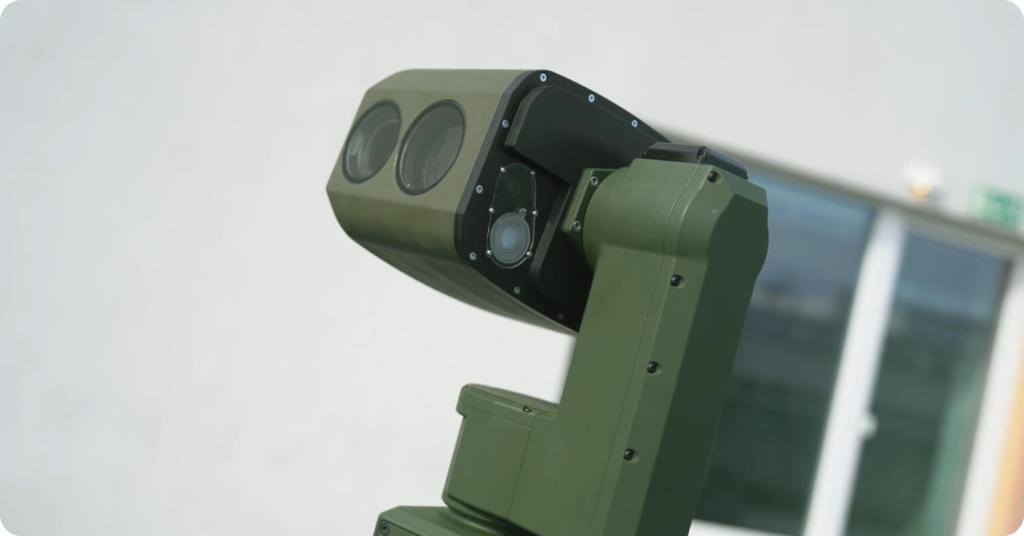
Recognizing that not every situation requires the Shark’s full suite of capabilities, Marduk also developed a more compact and agile counterpart: the Marduk Piraya. Weighing only around 10 kilograms, the Piraya is designed for rapid deployment. It can be mounted on a tripod for stationary defense or, crucially, integrated onto a vehicle, providing a protective bubble for forces on the move.
The core philosophy behind both systems is modularity. As CEO Martin Simon emphasizes, “It is evident that as drones come in a large variety of setups, the best way to detect, confirm and act against adverse drones is through a modular multi-sensor system.” Marduk’s platforms are designed to be the central nervous system of a counter-drone solution, seamlessly integrating with other sensors like radar and RF detectors, and a variety of effectors, from jammers that disrupt a drone’s electronics to lasers and even conventional remote weapon stations.
Forged in the Field: From Spring Storm to Live Fire
A defense startup’s technology is only as good as its performance under pressure. Marduk has consistently sought out the most demanding environments to prove the mettle of its systems. An early and crucial testing ground was provided by the Estonian Ministry of Defence, which recognized the potential of Marduk’s technology and awarded the company a grant from its defense industry competition. This support was instrumental, providing not just funding but a vital vote of confidence.
The team took their system to major military exercises, like “Spring Storm 2021.” These were not sterile lab tests. As Martin Simon recalled, “Some interesting challenges emerged as well, most of which were solved ad-hoc in the field. Our developers were very happy, saying the outdoor office was the coolest they have ever worked at!” This iterative, hands-on development, working directly with soldiers in realistic conditions, allowed them to rapidly refine their algorithms and improve the system’s stability and tracking capabilities. Their systems have since been used at NATO’s Ämari Air Base in Estonia, providing real-world operational experience.
The ultimate validation of their vehicle-mounted concept came in May 2025, during Estonia’s largest military exercise, “Siil 2025” (Hedgehog). A Marduk Piraya was integrated atop a CV90 infantry fighting vehicle of the elite Scouts Battalion. In a groundbreaking live-fire demonstration, the Piraya detected, tracked, and passed targeting data to the CV90’s main gun operator. The result was a stunning success: six quadcopters and several larger fixed-wing drones were neutralized with the formidable 35mm Bushmaster autocannon, one from a range of two kilometers.
Major General Andrus Merilo, Commander of the Estonian Defence Forces, was unequivocal in his praise: “It’s impressive that such a small target can be destroyed with essentially a single shot from a long distance. We can clearly see that the CV9035, already a highly capable vehicle, becomes even more effective with the addition of the right technical enhancements.” The exercise proved that Marduk’s passive system could give armored units a vital, self-contained defense against drone threats without revealing their own position.
Building Alliances: A Networked Defense
Marduk’s strategy extends beyond its own technological development. The company understands that the future of defense is collaborative. This has led to key partnerships with other leaders in the European defense industry.
One of the most significant collaborations is with fellow Estonian powerhouse Milrem Robotics, Europe’s leading developer of unmanned ground vehicles (UGVs). Together, they launched a mobile, autonomous C-UAS platform, mounting the Marduk Shark onto Milrem’s THeMIS UGV. This creates a revolutionary capability: an unmanned, mobile drone hunter that can be sent ahead of frontline forces to provide early warning and force protection. As Martin Simon noted, “Frontline forces on the move are most exposed to adversary drones. The mobile autonomous C-UAS platform gives our customers an additional layer of protection.”
This spirit of collaboration extends to sensor fusion as well. Marduk has worked closely with companies like the Netherlands-based Robin Radar Systems to integrate their advanced radars with the Shark’s electro-optical system. The radar provides long-range detection, cueing the Shark to lock on for precise visual identification and tracking. This multi-sensor approach drastically reduces false alarms and gives operators precious extra time to respond to a confirmed threat.
The real-world importance of this technology has been underscored by the conflict in Ukraine, where the use of rogue drones has become a grim reality of modern warfare. Marduk’s COO, Leet Rauno Lember, has shared his concerns about this threat, emphasizing that, “In order to save more lives it’s crucial to start using the emerging technologies by countering the threat caused by drones.” This sense of mission permeates the company, driving them to participate in high-level defense delegations to Ukraine and to continually refine their technology based on the evolving battlefield.
The Unblinking Eye of the Future
From its origins as a bold idea in the vibrant tech ecosystem of Tallinn, Marduk Technologies has emerged as a key player in the global counter-drone market. They have earned accolades from the Estonian Ministry of Defence, proven their systems in major NATO exercises, and demonstrated their life-saving potential in live-fire trials. They are active participants in major European Defence Fund projects, contributing to the continent’s collective security against the drone threat.
The story of Marduk is a testament to the power of a clear vision, deep technological expertise, and a relentless focus on solving a critical real-world problem. They are the digital embodiment of their ancient namesake, an unblinking eye in the sky, bringing order to the chaos of the 21st-century battlespace. As the drone threat continues to evolve, the silent, intelligent systems developed in Estonia will stand as a vigilant guardian, protecting soldiers on the move, securing critical infrastructure, and ensuring that the sky does not become a lawless frontier. The modern-day Marduks are on watch.