Revolutionizing Mobility in the Cosmos
In the burgeoning new space economy, where satellite constellations proliferate and ambitious missions to the Moon and Mars are no longer the realm of science fiction, the ability to precisely and efficiently navigate beyond Earth’s immediate vicinity has become paramount. This is where Impulse Space, a company born from the vision of a SpaceX founding engineer, is making its mark, fundamentally transforming in-space mobility. Their journey is a testament to the power of experienced leadership, vertical integration, and a clear focus on the critical need for reliable and rapid space transportation.
A Vision from the Rocket Man
The story of Impulse Space begins with Tom Mueller, a name synonymous with pioneering rocketry. As a founding member of SpaceX and the principal engineer behind the Merlin and Draco rocket engines – the very powerhouses of the Falcon 9 and Dragon spacecraft – Mueller possessed an unparalleled understanding of propulsion and space logistics. Recognizing a significant gap in the market for efficient and economical in-space transportation beyond initial launch, he founded Impulse Space in 2021.
Mueller’s vision was to “accelerate our future beyond Earth mobility from LEO to MEO, GEO, the Moon, Mars, and beyond,” as stated on the Impulse Space website. This ambition stems from the increasing demand across commercial, civil, and defense sectors for rapid, flexible, and cost-effective ways to maneuver payloads once they are in orbit. Traditional methods often involve complex and time-consuming maneuvers, limiting the responsiveness and optimizing the lifespan of space assets. Impulse Space was conceived to address this bottleneck, applying a deep understanding of propulsion to create agile “space tugs” that could swiftly deliver satellites to their precise orbital destinations.
The company’s approach from the outset has been one of vertical integration. As highlighted on their website, they understood that to control cost, schedule, and risk, it was essential to build out capabilities in-house. This strategy, implemented from day one, encompasses their 60,000-square-foot manufacturing facility in Redondo Beach, California, and engine test facilities in the Mojave Desert, allowing them comprehensive control over their development and production processes.
Powering the Journey: The Engines of Impulse

At the core of Impulse Space’s capabilities are their internally developed rocket engines, each meticulously designed for specific mission profiles.
- Saiph: This 5 lbf (22 N) thruster, utilizing a nontoxic bipropellant system of nitrous oxide and ethane, is a workhorse for the Mira orbital transfer vehicle. As Impulse Space announced in May 2023, Saiph underwent successful qualification, demonstrating remarkable endurance with a 12-minute continuous burn and 50,000 pulses over a 17-day period. Eight Saiph thrusters are incorporated into the Mira spacecraft, providing the precise maneuvering capabilities crucial for “last-mile” delivery and orbital adjustments. The company has also secured a contract with Vast, a commercial space station company, to provide Saiph thrusters and propulsion hardware for their Haven-1 mission, further validating its reliability.
- Rigel: Impulse Space’s first rocket engine, Rigel, was specifically designed for their Mars Lander vehicle. While details on its current deployment are more limited, its development signifies Impulse Space’s early ambition for deep-space exploration.
- Deneb: This powerful 15,000 lbf (67 kN) staged combustion cycle engine uses liquid oxygen (LOX) and methane as propellants. Deneb is the main engine for Impulse’s high-energy kick stage, Helios, designed to transport heavier payloads to higher energy orbits. Its development underscores Impulse Space’s commitment to delivering substantial propulsive power for demanding missions.

Orbital Transfer Vehicles: The Space Tugs
Impulse Space’s primary offerings are their orbital transfer vehicles (OTVs), often referred to as “space tugs,” designed to provide efficient and rapid payload delivery and hosting services across various orbital regimes:

- Mira: Approximately the size of a dishwasher and weighing around 300 kg when loaded with propellant, Mira is a compact yet highly capable orbital transfer vehicle. Powered by the Saiph thrusters, Mira is designed for precision maneuvers, constellation deployment, hosted payload services, and even precision reentry missions. It offers a delta-v of 500 m/s with a 300 kg payload and up to 900 m/s with a 100 kg payload. Mira’s first flight, as part of the SpaceX Transporter-9 mission, successfully launched in November 2023, demonstrating its chemical propulsion system for orbital adjustments. Impulse Space reported successful firings of all eight Saiph thrusters during this mission. Mira has also been contracted by Orbit Fab, funded by the Defense Innovation Unit (DIU), for a GEO in-space refueling mission, planned for 2025/26. The vehicle’s modular design ensures adaptability for various mission profiles.
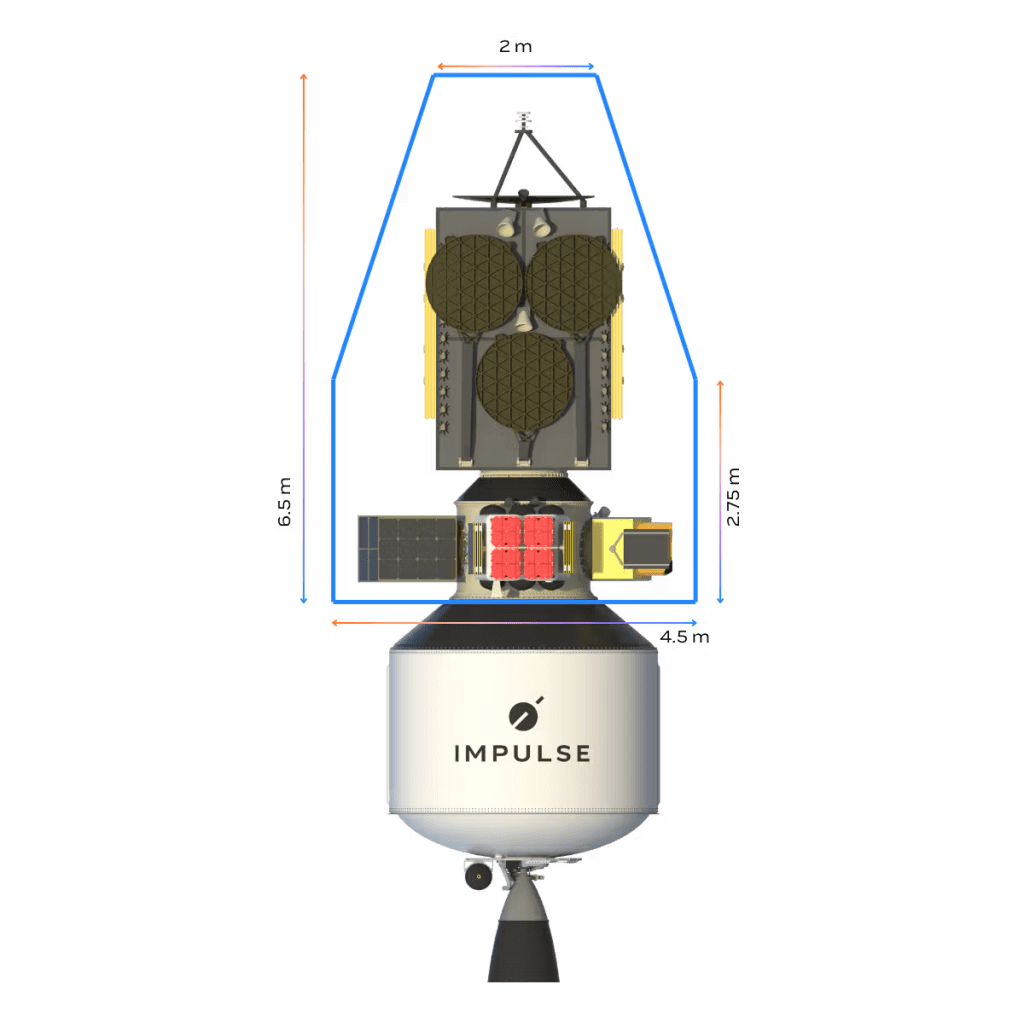
- Helios: Unveiled in January 2024, Helios is Impulse Space’s high-energy kick stage. Designed to propel payloads of up to 4 tons on a Falcon 9 or 5 tons on Relativity’s Terran R from Low Earth Orbit (LEO) directly into geostationary orbit (GEO), Helios represents a significant leap in in-space transportation capability. With a diameter just under 3.5 meters, it is sized to fit within a Falcon 9 fairing. Powered by the Deneb engine, Helios can burn up to 14,000 kg of liquid oxygen and liquid methane propellant. Its first flight is currently scheduled for 2026, with an initial mission planned for 2027 to lift four-ton SES satellites from LEO into GEO, as per a multi-launch agreement signed in May 2025. This capability is poised to transform the economics and speed of delivering large payloads to high-energy orbits.
Strategic Partnerships and Significant Funding
Impulse Space’s rapid ascent has been bolstered by a series of strategic partnerships and substantial funding rounds, reflecting strong investor confidence in their technology and market strategy.
- Relativity Space: A notable collaboration announced in July 2022 is with Relativity Space for a joint mission to Mars. Impulse Space is responsible for building the Mars lander itself, along with the cruise stage and entry capsule, while Relativity will provide the launch vehicle, the Terran R rocket, for a mission now targeting 2026. This ambitious project underscores Impulse Space’s capabilities for deep-space exploration.
- Orbit Fab: As part of the Defense Innovation Unit’s (DIU) efforts, Impulse Space partnered with Orbit Fab to refuel the USSF Tetra-5 satellite using the Mira OTV. This mission, planned for 2025/26, highlights their role in critical in-orbit servicing capabilities for national security assets.
- HEO Robotics: In February 2024, Impulse Space partnered with HEO to host their HOLMES-007 in-space imager on a Mira OTV as part of the LEO Express-2 mission. This marks the first commercial camera dedicated to non-Earth imaging in high LEO, enabling advanced satellite inspection capabilities.
- EXOLaunch: Impulse Space collaborated with Germany-based space logistics firm EXOLaunch in August 2024 to provide advanced separation systems for CubeSats and MicroSats, further enhancing satellite deployment capabilities.
- SES: A multi-launch agreement signed in May 2025 with SES, a global content and connectivity provider, marks a significant commercial validation for Helios. The agreement involves using Helios to rapidly transfer SES’s 4-ton class satellites from LEO to GEO, with the first mission planned for 2027.
- Sift: In April 2025, Impulse Space partnered with Sift, an observability platform for mission-critical hardware, to streamline data management and analysis for their complex missions. This collaboration enhances Impulse Space’s ability to monitor and optimize their in-space operations.
- U.S. Space Force: In October 2024, Impulse Space secured a $34.5 million contract from the U.S. Space Force under the Tactically Responsive Space (TacRS) program. This contract funds two ultra-mobile spacecraft missions, “Victus Surgo” and “Victus Salo,” designed to enhance military readiness in space operations, demonstrating their growing relevance in the defense sector.
The company has also seen substantial financial backing. As of June 2025, Impulse Space has raised a total of $525 million across multiple funding rounds. A significant Series C round, led by Linse Capital, closed in early June 2025, bringing in $300 million. This round saw participation from new investors like DFJ Growth, as well as returning investors including Valor Equity Partners, Founders Fund, Lux Capital, RTX Ventures, DCVC, and Airbus Ventures. This robust funding, coupled with over 30 signed contracts totaling nearly $200 million in value, allows Impulse Space to aggressively scale its production, accelerate R&D for longer-duration missions, and develop new vehicles for national security and NASA applications.
The Future: Mobilizing the Cosmos
Impulse Space is not just building rockets; they are building the future infrastructure of space. By providing agile, economical, and reliable in-space transportation services, they are unlocking new possibilities for satellite deployment, orbital servicing, and deep-space exploration. Their vertically integrated approach, combined with the deep expertise of a team led by a space industry titan, positions them as a critical enabler for the expanding space economy.
As the demand for in-space mobility continues to skyrocket across commercial, civil, and defense sectors, Impulse Space’s fleet of advanced vehicles, particularly Mira and Helios, stands ready to meet this need. Their contributions are vital for optimizing satellite constellations, enabling tactically responsive space capabilities for defense, and facilitating the ambitious civil missions that will push humanity further into the cosmos. Impulse Space is indeed mobilizing space, reliably and rapidly getting customers where they want to go, and in doing so, shaping a new era of space exploration and utilization.