Pioneering Robotics for the Final Frontier (and Beyond)
The future of humanity, and indeed, its security, is increasingly tied to space. From vital communication networks to critical surveillance capabilities, our orbital domain is no longer just a realm of scientific curiosity but a strategic battleground. Within this rapidly evolving landscape, companies are emerging that push the boundaries of what’s possible, not just for exploration, but for defense. One such innovator, rapidly gaining traction, is GITAI.
Hailing originally from Japan and now headquartered in Torrance, California, GITAI isn’t merely building robots; it’s crafting the very hands that will construct, maintain, and safeguard our presence in space. Their vision is bold: to slash the cost of in-space labor by a hundredfold, thereby democratizing access to the cosmos and enabling a sustained human (and robotic) presence far beyond Earth. While their primary focus has been on civilian applications – on-orbit servicing and lunar infrastructure construction – GITAI’s groundbreaking advancements in autonomous robotics, satellite technology, and intelligent systems inherently position them as a crucial player in the burgeoning space defense sector.
The Genesis of a Space Robotics Revolution
GITAI’s journey began with a fundamental question: how can we make work in space safer and more affordable? The answer, for founder and CEO Sho Nakanose, lay in advanced robotics. Recognizing the immense costs and dangers associated with human operations in the harsh vacuum of space, Nakanose established GITAI in 2016. His ambition was not just to replace astronauts, but to augment their capabilities, freeing them for higher-level tasks while robots handled the repetitive, risky, or precision-demanding work.
What sets GITAI apart from traditional aerospace companies is their embrace of an agile development methodology. Unlike the lengthy, sequential “waterfall” model often seen in the space industry, GITAI prioritizes rapid iteration, continuous testing, and a culture of experimentation. This nimble approach allows them to design, build, and evaluate their robotic systems at an accelerated pace, ensuring their products are robust enough to withstand the unforgiving space environment and meet evolving customer demands. Their commitment to in-house manufacturing of critical components further solidifies their control over quality and reduces reliance on external supply chains – a crucial advantage, particularly for defense applications where supply chain resilience is paramount.
Robotic Arms: The Workhorses of Space
At the heart of GITAI’s technological prowess are their highly capable robotic arms. These aren’t just industrial manipulators; they are sophisticated, modular systems designed for the unique challenges of microgravity and lunar environments. Their 1.5-meter and 2-meter dual robotic arm systems, like the S2, boast 8-degrees-of-freedom, enabling them to perform a wide array of intricate tasks.
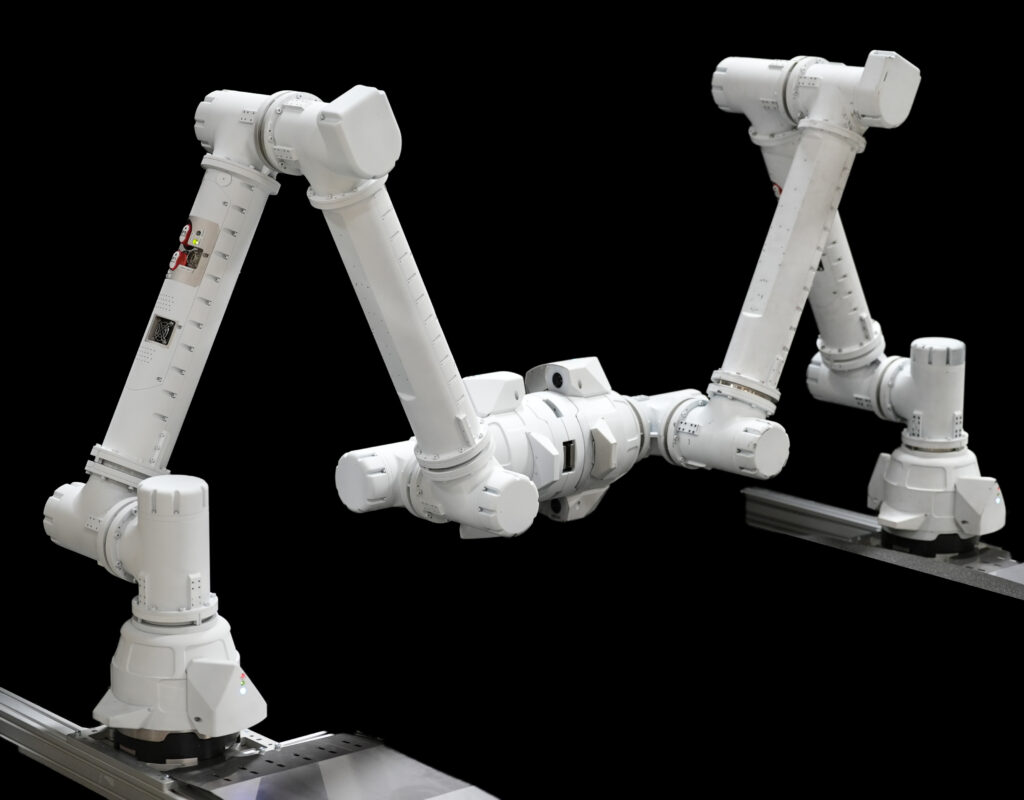
Imagine a satellite in orbit needing a component replaced, a thermal blanket adjusted, or a connector mated. Traditionally, this would require a costly and dangerous spacewalk by astronauts. GITAI’s robotic arms are designed to handle such “in-space servicing, assembly, and manufacturing” (ISAM) operations with precision and autonomy. They have already demonstrated their capabilities successfully inside the International Space Station (ISS) in 2021 and, notably, outside the ISS in 2024. These demonstrations achieved NASA’s Technology Readiness Level (TRL) 7, signifying that the technology is fully operational in a relevant space environment. This TRL 7 equivalence also applies to their innovative “Inchworm” type robotic arm, which shares many core components with the S2 system.
These robotic arms are not just for existing satellites. They are integral to GITAI’s vision for on-orbit servicing and lunar infrastructure construction. For defense, this translates into unprecedented capabilities for maintaining and upgrading military satellites, extending their operational life, or even performing rapid repairs in contested environments. The ability to autonomously repair or reconfigure satellite constellations could provide a significant strategic advantage, ensuring continued intelligence, surveillance, and reconnaissance (ISR) capabilities.
Lunar Ambitions: Building the Future on the Moon
Beyond Earth orbit, GITAI is setting its sights on the Moon. Their lunar robotic rovers, such as the R1, are being developed for exploration, mining, inspection, and, crucially, infrastructure assembly. The company envisions a future where autonomous robots construct essential lunar infrastructure like communication antennas, solar panels, and even habitation modules.

This lunar focus has direct implications for defense. As nations increasingly recognize the strategic importance of the Moon, the ability to establish and maintain a presence there becomes critical. GITAI’s lunar robots, particularly their inchworm-type arms and rovers, are designed to build and maintain the foundational elements of lunar bases, which could serve as vital outposts for scientific research, resource utilization, and even defense-related operations. Their selection for DARPA’s 10-Year Lunar Architecture (LunA-10) project underscores the strategic significance of their work in this domain. Imagine a future where defensive assets, from surveillance systems to communications relays, are autonomously constructed and maintained on the lunar surface by GITAI’s robots.
The Defense and Space Link: A Strategic Move
Recognizing the immense potential of their technology for national security, GITAI made a strategic move in April 2025 by establishing GITAI Defense and Space LLC. This new subsidiary, incorporated in Delaware and operating from their California headquarters, is specifically designed to serve as a prime contractor for U.S. Department of Defense (DoD) and NASA programs.
This isn’t merely a rebranding; it’s a structural adjustment to meet stringent U.S. government contracting requirements. By structuring the subsidiary under a voting trust, with 51% ownership by a U.S. trust company, GITAI Defense and Space LLC qualifies for prime contractor roles. This move signals a clear commitment to supporting national security missions, particularly by providing satellite buses for defense-oriented constellations and their proprietary robotic solutions for on-orbit servicing.
The implications are far-reaching. For the defense sector, this means access to cutting-edge robotics that can contribute to:
- Satellite Constellation Maintenance: Ensuring the longevity and resilience of critical defense satellite networks.
- On-Orbit Servicing for National Security Assets: Repairing, refueling, or upgrading sensitive government and military satellites without de-orbiting them.
- Lunar Defense Infrastructure: Potentially establishing and maintaining defensive capabilities on the Moon.
- Reduced Risk to Personnel: Automating hazardous tasks in space, minimizing the need for human exposure to dangerous environments.
The Role of AI, C4ISR, and Cybersecurity
While GITAI’s core strength lies in its robotic hardware, the intelligence that drives these systems is equally crucial. Their robots are designed for autonomy, which inherently involves sophisticated AI capabilities. This AI allows the robots to interpret their environment, plan complex movements, and execute tasks with minimal human intervention. In a defense context, AI-powered autonomous space robots could perform tasks such as:
- Automated Inspection and Diagnostics: Rapidly identifying damage or malfunctions on orbiting assets.
- Autonomous Repair and Assembly: Performing intricate repairs or building new structures without real-time human control, critical for speed and efficiency in a high-stakes environment.
- Adaptive Mission Planning: Adjusting to unforeseen circumstances or changing mission objectives in space.
Furthermore, any advanced space operation, particularly for defense, relies heavily on robust C4ISR (Command, Control, Communications, Computers, Intelligence, Surveillance, and Reconnaissance) systems. While GITAI doesn’t directly produce C4ISR hardware in the traditional sense, their robotic systems are inherently designed to integrate seamlessly into such networks. Their ability to communicate reliably with mission control centers, transmit image and video data, and receive complex commands makes them a vital component of any future space-based C4ISR architecture. Their successful demonstration of reliable communication with their 16U SC1 satellite is a testament to this capability.
Cybersecurity is another critical aspect that GITAI takes seriously, especially when operating within the sensitive defense domain. The company announced in December 2023 that it received the National Institute of Standards and Technology (NIST) SP800-171 compliance certification. This certification is crucial as it protects the confidentiality of controlled unclassified information (CUI), which often includes design specifications for weapons, communications, and space systems. By adhering to these stringent cybersecurity standards, GITAI positions itself as a trustworthy partner for government agencies, mitigating risks associated with data breaches or unauthorized access to critical space technologies.
Beyond the Horizon: Unmanned Systems and Satellites
While their robotic arms and lunar rovers are the visible manifestations of their work, GITAI’s broader ambition encompasses the development of full unmanned naval systems (though their focus is currently space, the underlying autonomy principles are transferable) and, critically, satellites. Their successful demonstration of their in-house developed 16U SC1 satellite in December 2024 was a significant milestone. This satellite not only validated reliable communication and system functionality but also proved GITAI’s capability to develop robotic satellites for on-orbit services. This positions them to offer end-to-end solutions, from designing and manufacturing spacecraft to coordinating launches and operating them from their control center.
This vertical integration, from robotic arm to satellite bus, is a game-changer. It allows GITAI to overcome supply chain bottlenecks and offer more cost-effective and faster solutions compared to competitors who might rely heavily on external suppliers. For defense, this means a more agile and responsive partner for deploying and maintaining critical orbital assets. Future plans include a 2026 mission to demonstrate rendezvous and docking capabilities with a 500kg-class satellite equipped with a robotic arm and a target satellite, further solidifying their on-orbit servicing prowess.
The Natural Narrative: Curiosity and Impact
GITAI’s story is one of audacious ambition, technical mastery, and strategic foresight. What makes their narrative so compelling is not just the “what” – advanced space robots – but the “why.” Their driving force is to unlock the economic and scientific potential of space by making it accessible and safe. This core mission, coupled with their agile development and in-house manufacturing, fosters a sense of curiosity. Readers are naturally drawn to understand how a relatively young company is achieving such complex feats in an industry traditionally dominated by giants.
The shift into the defense sector, far from being a deviation, is a natural extension of their foundational strengths. The same autonomy, precision, and resilience required for building a lunar base are precisely what the defense sector needs for its space-based operations. By providing factual information about their technological achievements, strategic partnerships with entities like DARPA and NASA, and their commitment to cybersecurity, the story of GITAI becomes more than just a company profile; it becomes a glimpse into the future of space, where robots play an increasingly vital role in securing our interests in the ultimate high ground.
GITAI is not just building robots; they are building the future of work in space, a future that is safer, more affordable, and increasingly, more secure. As the defense landscape expands beyond terrestrial boundaries, companies like GITAI, with their innovative spirit and proven capabilities, will undoubtedly be at the forefront, shaping the realities of the final frontier.