Innovating Vertical Flight: Flyt Aerospace’s Journey in UAV and Personal eVTOL Development
Flyt Aerospace, founded in 2014 and headquartered in San Jose, California, is a private company specializing in the development of unmanned aerial vehicles (UAVs) and personal electric vertical takeoff and landing (eVTOL) aircraft. With a mission to make personal VTOL transportation accessible to everyone, Flyt has expanded its focus to include UAVs designed for first responders and government use, emphasizing cutting-edge technology at affordable price points.
Company Background
Flyt Aerospace, also known as Aperture Aerospace Industries, was established with the vision of bringing personal VTOL transportation to the masses. Over the years, the company has diversified its offerings to cater to various sectors, including defense and emergency services. The company’s founder, Ansel Misfeldt, brings over nine years of experience in the drone and eVTOL industry, leading the design and engineering efforts behind Flyt’s innovative products.
Product Portfolio
Defender X4E
The Defender X4E is a small eVTOL drone designed for government and military applications. It boasts a maximum payload capacity of 5 pounds (2.27 kg) and an endurance of over one hour. The drone is designed to be adaptable to various customer requirements, making it suitable for a range of mission-critical operations.

Supply Drone
Flyt Aerospace has developed a concept design for a heavy-lift eVTOL air cargo drone, known as the Supply Drone. This multicopter swarm drone is tailored for military applications, capable of carrying a maximum payload of 300 pounds (136 kg). It features 12 ducted propellers powered by electric motors and is constructed with a carbon fiber composite fuselage. The drone is designed for low-altitude flying to minimize detection and enhance safety in hostile environments.
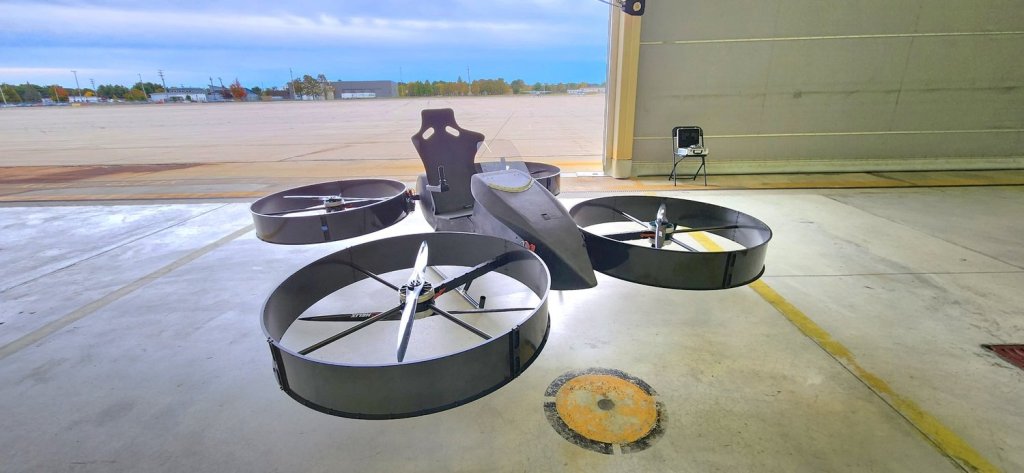
FlytCycle V3
The FlytCycle V3 is a one-passenger eVTOL concept aircraft intended for personal use in advanced air mobility (AAM). It features an open cockpit with dual joysticks for manual control, emphasizing the joy of personal flight. The aircraft is not designed for remote or autonomous piloting, highlighting Flyt’s commitment to human-scale flight experiences.
Technological Innovations
Flyt Aerospace’s approach to innovation involves iterative design and hands-on problem-solving. The company’s development process is characterized by rapid prototyping and testing, often addressing challenges through creative engineering solutions. For instance, during the development of early prototypes, the team experimented with various landing gear configurations to address stability issues, showcasing their commitment to refining their designs through practical experimentation.
Industry Recognition and Collaborations
Flyt Aerospace’s Defender UAV was a winning entry in the National Institute of Standards and Technology (NIST) Triple Challenge, focusing on cybersecurity and Wi-Fi coverage. This recognition underscores the company’s capabilities in developing UAVs that meet stringent security and communication requirements .
Additionally, Flyt has partnered with Land Rotor, a Florida-based company, to develop passenger eVTOL aircraft for advanced air mobility applications. This collaboration aims to further the development of personal flight solutions, aligning with Flyt’s original mission of making VTOL transportation accessible.
Future Outlook
Flyt Aerospace continues to focus on recruiting and fundraising efforts to support the development of the next iteration of the FlytCycle. The upcoming version is expected to feature numerous safety upgrades and performance improvements, reflecting the company’s ongoing commitment to enhancing personal flight experiences.
Conclusion
Flyt Aerospace stands at the intersection of UAV innovation and personal eVTOL development. With a diverse product portfolio catering to both government applications and individual users, the company demonstrates a unique blend of technological prowess and visionary ambition. As Flyt continues to refine its designs and expand its collaborations, it remains a notable player in the evolving landscape of vertical flight technology.