Redefining Reconnaissance with Amphibious Inflatable Drones
In the challenging and often unpredictable environments of defense, security, and emergency services, the demand for versatile, robust, and rapidly deployable unmanned aerial vehicles (UAVs) is constant. Standing at the forefront of innovation in this space is DIODON Drone Technology, a French company that has pioneered the world’s first inflatable and amphibious multirotor drones. From its origins in Toulouse in 2015, DIODON has carved out a unique niche, providing solutions that are not just easy to transport and rugged, but critically, can operate seamlessly from land and water, making them ideal for intelligence, surveillance, and reconnaissance (ISR) missions in the harshest conditions.
An Inflatable Vision for Unmanned Versatility
DIODON Drone Technology was founded in 2015 by Roman Luciani (and initially Antoine Tournet, according to earlier reports). The idea stemmed from a clear need for drones that could overcome the limitations of traditional rigid-frame UAVs, particularly in demanding environments. The founders recognized that conventional drones often struggled with portability, deployment in confined spaces, and vulnerability to impacts and water. Their solution? An inflatable structure that would grant unparalleled resilience, compactness, and amphibious capabilities.
The company’s journey began with ambitious young engineers and quickly moved from conceptualization to tangible prototypes. As mentioned by Aerospace Valley, DIODON’s core innovation lies in developing and producing the first inflatable multirotor drones available on the market. This unique design allows the drones to be deflated for easy portability, enabling a single operator to deploy them rapidly, even in rough conditions. This focus on user-friendliness and adaptability has been central to DIODON’s development philosophy from the outset.
The DIODON Product Line: HP30, SP20, and MP40
DIODON Drone Technology offers a family of inflatable drones, each designed to meet specific operational requirements, though the HP30 stands out as their flagship for professional use.
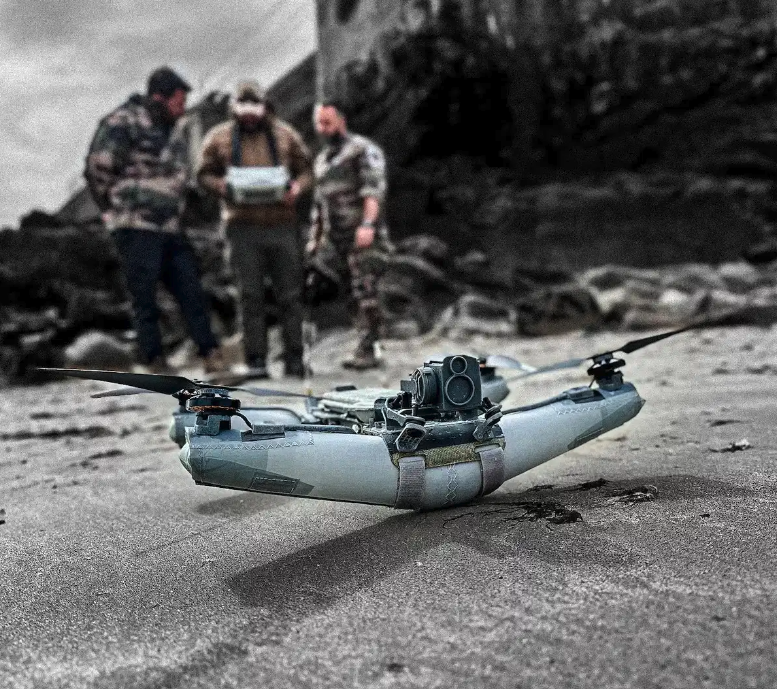
- DIODON HP30: This is the company’s leading professional-grade micro-drone, weighing under 2 kg, specifically adapted for defense, security, and inspection missions in challenging maritime and aquatic environments. As detailed on DIODON’s website, the HP30 boasts an IP56+ waterproofing rating, ensuring robust performance in heavy rain or directly from water. Its inflatable arms not only facilitate compact transport but also provide native buoyancy, allowing it to safely land and take off from water. The HP30 can be deployed in under 60 seconds, offers up to 30 minutes of flight time (with a max endurance of 180 minutes in specific configurations), and has a range of 3 nautical miles (approximately 5.5 km), with communication systems encrypted for military-grade security. It integrates high-performance optical and thermal (IR) sensors for accurate detection, reconnaissance, and identification of points of interest, transmitting direct HD quality video. The HP30’s rugged inflatable structure gives it high resistance to shocks, making it resilient in poor conditions. Its unique design also includes a fully autonomous flip feature, allowing it to right itself if it lands upside down in the water.
- DIODON SP20 and MP40: While the HP30 is their primary focus for demanding professional applications, earlier models like the SP20 and MP40 demonstrated the core inflatable technology. These earlier variants also offered waterproof capabilities and compact designs, paving the way for the more advanced HP30.
All DIODON drones are designed to be all-terrain, capable of deployment and use by a single operator. The interchangeability of sensors allows the drones to be adapted to specific mission needs, providing versatility for various intelligence, surveillance, and reconnaissance operations.
Amphibious Advantage: A Game-Changer for Maritime Operations
The true distinguishing feature of DIODON drones is their unparalleled amphibious capability. The inflatable design allows them to:
- Launch and Land on Water: This eliminates the need for specialized launch and recovery infrastructure on boats or in wet environments, making them ideal for naval forces, coast guards, and maritime police.
- Shock Resistance: The inflatable arms provide inherent shock absorption, making them remarkably robust against impacts during deployment or in challenging flight conditions.
- Compactness and Portability: When deflated, the drones fold into a very small, backpack-portable form factor, allowing for discreet transport and rapid deployment from small vessels, vehicles, or by dismounted personnel.
This unique combination of features makes DIODON drones particularly valuable for maritime professionals, enhancing mission reach and versatility from RHIBs (Rigid-Hulled Inflatable Boats), FPVs (Fast Patrol Vessels), and USVs (Unmanned Surface Vessels) without requiring additional infrastructure.
Battle-Proven Applications and Strategic Partnerships
DIODON drones have moved beyond conceptual designs to active deployment with demanding operators globally, including various defense and security forces.
- Naval Operations: Their inherent seaworthiness makes them a natural fit for navies and special forces operating in littoral or open-sea environments. As highlighted by Shephard Media, the DIODON HP30 was successfully launched from an unnamed French Navy SSN (nuclear attack submarine) while submerged at periscope depth. Encased in a waterproof “cocoon” by Naval Group, the UAV was released, inflated upon reaching the surface, and took off. This demonstrates a groundbreaking capability for covert reconnaissance from underwater platforms. Furthermore, the company’s website states that since 2022, DIODON drones have been equipping all-sized defense and security boats internationally.
- Reconnaissance and Surveillance: The drones are extensively used for ISR missions in harsh environments, providing critical aerial intelligence for situational awareness. Their ability to operate in adverse weather conditions, heavy rain, or snowfall gives units a significant operational edge when other drone systems might be grounded.
- Homeland Security and Emergency Services: Beyond military applications, DIODON drones are also deployed by homeland security and emergency services for search and rescue, border patrol, and surveillance in difficult-to-access or hazardous areas.
- International Deployments: DIODON systems are reportedly used by armies and navies in several countries, including Denmark, Britain, France, and the Netherlands. Asian News Network reported on a demonstration by Singapore’s Police Coast Guard Special Task Squadron using the DIODON HP30 for real-time aerial surveillance during a simulated pirate boarding, enhancing commanders’ situational awareness and decision-making.
DIODON has also secured partnerships to expand its reach and capabilities. For instance, Barfield, AFI KLM E&M’s American subsidiary, signed an agreement with DIODON Drone Technology to sell and support its UAS in the Americas. Furthermore, DIODON is a participant in the European Defence Fund (EDF) project “Tactical Drones in Rain and Icing Conditions,” alongside other European partners, focusing on enhancing drone resilience in extreme weather. Earlier, in 2021, Delta Drone acquired a stake in DIODON Drone Technology, providing increased financial resources for the industrialization and commercialization of the HP30. This also forged strong links with French naval defense players like Nexeya and Naval Group, who supported the drone’s development.
Conclusion
DIODON’s success stems from its commitment to innovation driven by operational feedback. The HP30, for example, was developed based on “7 years of operational feedbacks from the world’s most demanding drone operators.” This user-centric approach ensures that their products truly meet the needs of professionals operating in the field.
The company’s ground control stations (GCS) are designed to be user-friendly, even with gloves, and built to withstand the same harsh conditions as the drones themselves. They also offer specialized maritime training for pilots, ensuring operational excellence and mission readiness for end-users worldwide.
DIODON Drone Technology’s journey from a startup with an unconventional idea to a supplier for elite defense forces underscores the power of specialized innovation. By continuously refining their unique inflatable and amphibious drone technology, they are not only solving critical operational challenges but also empowering military, security, and emergency services personnel with unprecedented capabilities for intelligence, surveillance, and rapid response in any environment. As the world continues to demand more agile and resilient unmanned solutions, DIODON stands ready to provide the aerial eyes and ears for the toughest missions.