Forging the Future of Defense and Space with Materials Born of Fire
In the relentless pursuit of speed, altitude, and resilience, the defining limits are often not in the ambition of our designs, but in the very materials from which they are built. For rockets to punch through our atmosphere and for hypersonic vehicles to slice through it at unimaginable speeds, they require components that can withstand the inferno of extreme temperatures and colossal stress. Most metals, for all their strength, warp and fail under such du condiciones. This is the frontier of material science, a place of immense challenge and extraordinary opportunity. It is here, in the Dutch city of Delft, that a startup named Arceon is quietly forging a revolution, creating the materials of the future for the high-stakes worlds of defense and space.
This is not a story of a simple new alloy or a minor process tweak. It’s the story of a fundamental shift in how we build the machines that operate at the edge of possibility. It’s the story of Arceon’s mission to master and democratize one of the most promising classes of materials ever conceived: Ceramic Matrix Composites (CMCs).
From the University Lab to a Market in Need
The seed for Arceon was planted in the fertile ground of academic research at the renowned Delft University of Technology (TU Delft). Founder and CEO, Rahul Shirke, an aerospace structures and materials expert, had dedicated years to the study of advanced ceramic composites. He saw the immense theoretical promise of these materials – their astonishing heat resistance, light weight, and durability. Yet, he also saw a chasm between their potential and their real-world application.
The problem was one of accessibility. Historically, producing CMCs was a painstakingly slow and prohibitively expensive process, often taking months to create a single component. This bottleneck confined their use to a handful of highly specialized, cost-is-no-object government projects. Shirke recognized the immense untapped market: countless companies in the burgeoning private space industry and the ever-evolving defense sector were grappling with thermal and structural challenges that CMCs could solve, if only they were available faster and more affordably.
Driven by a passion for innovation that pushes humanity forward, Shirke embarked on his entrepreneurial journey in 2017. The vision was clear: to bridge the gap between the laboratory and the launchpad. He wasn’t alone in this endeavor. He joined forces with co-founders Bernhard Heidenreich, a veteran researcher from the German Aerospace Center (DLR) with over 80 publications on CMCs to his name, and Rahul Sharma, a product development and project management specialist with a background in the automotive industry. Together, this trio formed the nucleus of Arceon, a company built on a foundation of deep technical expertise and a pragmatic approach to industrialization.
The Arceon Difference: Material as a Service
What sets Arceon apart is their philosophy. They are not merely a supplier of materials; they are a co-development partner. They understand that for their clients in the aerospace and defense industries, a component is never just a component. It’s a critical piece of a complex puzzle, with demanding requirements for thermal load, structural integrity, and seamless integration.
Arceon’s approach is to work hand-in-glove with their clients. The process begins with a deep dive into the customer’s challenge. From there, the team at their Delft facility—a growing hub of engineers and material scientists—embarks on a journey of formulation, prototyping, testing, and redesign. They handle every step in-house, a crucial element that allows for rapid iteration and a tightly controlled development cycle. This “Material as a Service” model ensures that the final product is not just a piece of ceramic, but a bespoke solution, perfectly tailored to the specific and extreme use case.
The fruits of this labor are finding their way into the heart of the world’s most advanced systems. Arceon’s components are being integrated into thermal protection systems for spacecraft, next-generation propulsion systems, and critical military hardware. These are environments where temperatures can soar beyond 1500°C, where corrosive elements are a constant threat, and where failure is simply not an option. In one instance, Arceon designed a ceramic composite for a propulsion system where no metal could survive. In another, their materials replaced a costly, multi-part metal assembly with a single, elegant component that could withstand both immense mechanical loads and chemical exposure.
Carbeon: The Backbone of the Revolution
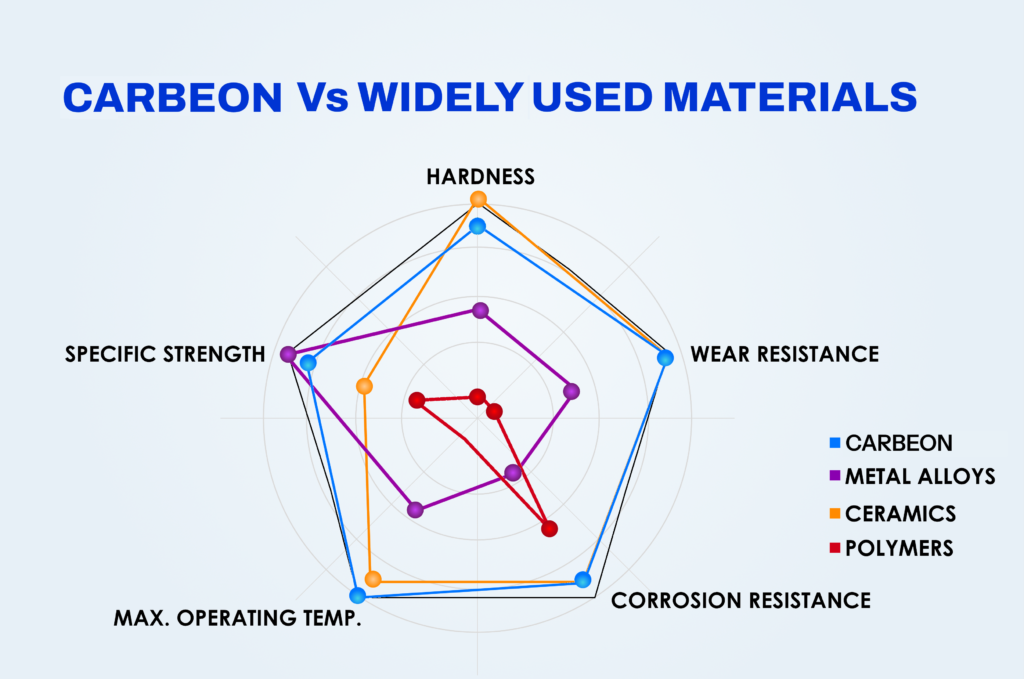
At the heart of Arceon’s technological prowess is their flagship material: Carbeon. This advanced C/C-SiC composite, a blend of carbon fiber and silicon carbide, is a marvel of material science. It embodies a combination of properties that make it ideal for the extreme environments of space and defense.
Carbeon is significantly lighter than the metal alloys it often replaces, a critical advantage in aerospace where every gram counts. It boasts an ultra-high temperature resistance and a near-zero coefficient of thermal expansion, meaning it maintains its shape and structural integrity even when subjected to dramatic temperature swings. This stability is vital for sensitive applications, such as components used near optical systems, as Carbeon exhibits no detectable outgassing in a vacuum.
Furthermore, its enhanced fatigue life and damage-tolerant nature make it a reliable choice for long-duration missions and reusable vehicles. But perhaps the most disruptive element of Arceon’s offering is not just the material itself, but the process behind it. The company has pioneered a fast, scalable, and cost-effective melt infiltration process. This innovative manufacturing technique is the key that unlocks the widespread use of CMCs, breaking down the barriers of time and cost that have long held the technology back.
Nurtured for Success: The YES!Delft Advantage
The journey from a brilliant idea to a thriving deep-tech company is fraught with challenges. For Arceon, a crucial catalyst in their growth was their acceptance into the YES!Delft accelerator program in 2020. This ecosystem, one of Europe’s leading tech incubators, provided the perfect environment for a startup rooted in hardcore materials science to flourish.
At YES!Delft, the Arceon team gained access to a network of expert mentors and hands-on guidance in business development. This experience was instrumental in shifting their mindset from one focused purely on research to one driven by real-world application and market needs. They learned to ask the critical questions: What specific problems are we solving? Who are our customers? And how can we deliver our technology to them more efficiently?
The program also provided a vital sense of community. Surrounded by other ambitious deep-tech founders tackling similarly complex challenges, Shirke and his team found the support and perspective necessary to navigate the arduous path of scaling up their operations.
Reaching for the Stars and Securing the Skies
Arceon’s vision has always been twofold: to enable the next generation of space exploration and to enhance the capabilities of the defense sector. Their work is a testament to this dual focus. The company is actively involved in projects that will push the boundaries of our presence in the cosmos, including engineering and manufacturing advanced CMC parts for a mission aimed at exploring the lunar surface.
More recently, in a landmark achievement, Arceon has made a significant foray into the highly competitive U.S. defense market. In June of 2025, General Atomics Aeronautical Systems, Inc. (GA-ASI), a global leader in unmanned aerial systems, announced a strategic investment in the Dutch startup. This collaboration, born out of the “Blue Magic Netherlands” initiative designed to foster innovation between GA-ASI and Dutch industry, is a powerful endorsement of Arceon’s technology.
GA-ASI sees a broad range of applications for Arceon’s materials, from high-temperature engine exhaust systems to the cutting-edge realm of hypersonics and even fusion containment. For Arceon, this partnership is more than just a capital investment; as Rahul Shirke stated, it marks their “official entry into the U.S. defense sector, presenting an extraordinary opportunity to demonstrate our technology on a global stage.”
The Future is Forged in Ceramic
Arceon’s journey is a compelling example of how deep scientific research, when combined with entrepreneurial vision and a relentless focus on solving real-world problems, can lead to transformative innovation. They are not just creating new materials; they are enabling new possibilities. By making advanced ceramic composites more accessible, they are empowering engineers and designers in the defense and space sectors to build lighter, faster, and more resilient systems.
The long game for Arceon is to become a European leader in high-performance ceramic composite components. This will involve continuous investment in research and development, the expansion of their production capabilities, and the cultivation of a growing base of industrial clients who depend on their materials to operate where others fail.
In a world where strategic advantage is increasingly defined by technological superiority, the materials that underpin our most advanced systems are more critical than ever. Arceon, born from the crucible of academic excellence and forged in the fire of entrepreneurial ambition, is providing the building blocks for the future of defense and space exploration. Their story is a powerful reminder that sometimes, the biggest revolutions begin with the smallest, strongest, and most heat-resistant of things.