Redefining Tactical Airlift with Next-Generation VTOL Technology
Founded in 2024 in Lithuania, Airvolve is an emerging aerospace and defense startup developing a new class of vertical takeoff and landing (VTOL) aircraft designed to replace conventional helicopters in tactical, humanitarian, and emergency logistics missions. With a focus on modularity, cost-efficiency, and operational flexibility, Airvolve’s aircraft aims to address critical gaps in battlefield mobility and civil safety operations.
Company Overview
Airvolve, officially known as Airvolve, UAB, was established in June 2024 in Kaunas, Lithuania. The company was co-founded by Donatas Gendvilas, who serves as the CEO, and Antanas Ivancius, the Chief Growth Officer (CGO). Drawing on a multidisciplinary team that includes professionals with previous experience at NASA, Airbus, Boeing, and the Lithuanian Armed Forces, Airvolve is built on a foundation of robust aerospace and defense knowledge. Since its inception, the company has raised €825,000 in seed funding from notable investors such as Coinvest Capital, Baltic Sandbox Ventures, and a group of angel investors. This capital injection is aimed at accelerating the development of their vertical takeoff and landing (VTOL) aircraft and preparing it for production and deployment. The company operates primarily from its headquarters in Lithuania but maintains a global outlook, particularly in defense innovation circles.
Mission and Vision
Airvolve’s mission is to develop a cost-effective and versatile VTOL aircraft capable of performing various missions, including cargo delivery, casualty evacuation, and special operations support. The company envisions a future where tactical airlift is more accessible, efficient, and adaptable to diverse operational environments.
Technological Innovations
1. Unique Propulsion System
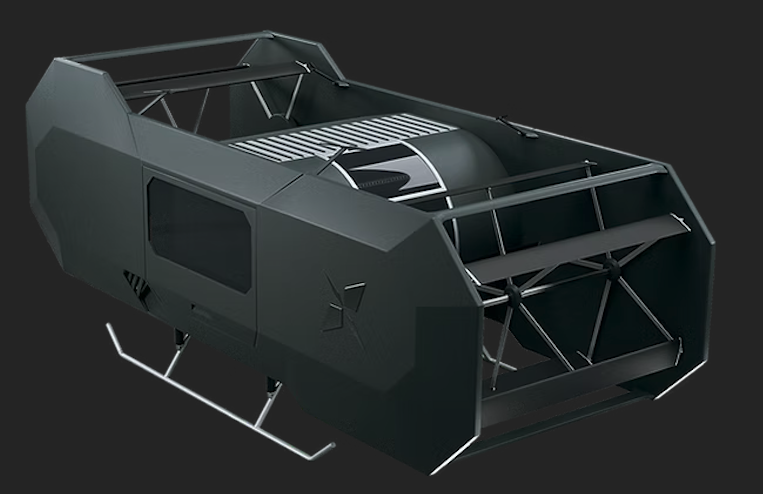
Airvolve’s aircraft features a horizontal-axis rotor system that combines the efficiency of helicopters with the aerodynamic advantages of fixed-wing aircraft. This design enables silent operation and improved fuel efficiency, making it suitable for stealth missions and operations in noise-sensitive areas.
2. Compact and Transportable Design
The aircraft is designed to fit into a standard 20-foot container without requiring reassembly, allowing for rapid deployment and ease of transportation. This feature is particularly beneficial for military operations and disaster response scenarios where mobility and quick setup are crucial.
3. Advanced Control Options
Airvolve’s VTOL platform supports multiple control modes, including autonomous operation, remote piloting, and semi-manual onboard control. This flexibility allows operators to choose the most appropriate control method based on mission requirements and operational constraints.
4. Safety and Security Features
The aircraft incorporates anti-first-person view (FPV) protection and minimal thermal emissions to enhance operational security and reduce detectability. These features are essential for missions in contested or sensitive environments.
Performance Specifications
Airvolve’s aircraft is engineered to deliver optimal performance for tactical and humanitarian missions. The aircraft can carry payloads up to 200 kilograms, housed within a cargo compartment that offers five cubic meters of usable volume. It is designed to operate over a range of approximately 100 kilometers, making it suitable for short- to medium-range logistics and emergency missions. One of its most innovative design elements is its compatibility with standard transportation infrastructure—the aircraft can be packed into a conventional 20-foot container, enabling rapid deployment and simplified logistics. To enhance mission flexibility, the aircraft supports various control modes, including fully autonomous navigation, remote piloting, and semi-manual control from onboard systems. This level of adaptability is intended to meet diverse operational requirements in both military and civilian scenarios.
Development Milestones
Airvolve has achieved several key milestones in its development journey:
- Critical Design Review (CDR): Completed in November 2024, marking the transition from design to manufacturing.
- Prototype Testing: Conducted extensive computational fluid dynamics (CFD) and finite element analysis (FEA) simulations, followed by lab and field testing. Thrust measurements exceeded simulations by over 50%, demonstrating the aircraft’s performance capabilities.
- Manufacturing Initiation: Commenced the manufacturing process post-CDR, aiming to develop a fully functional minimum viable product (MVP) aircraft.
Strategic Partnerships and Recognition
Airvolve has established partnerships and received recognition within the aerospace and defense industry:
- Collaborations: Engaged in projects with major aerospace companies such as Airbus, Boeing, and Thales, leveraging their expertise to enhance its VTOL platform.
- Industry Recognition: Featured by NextGen Defense as a defense disruptor, highlighting its innovative approach to tactical airlift solutions.
- Startup Accolades: Recognized by F6S as one of the top manufacturing startups in Lithuania, reflecting its potential and growth trajectory.
Applications and Use Cases
Airvolve’s VTOL aircraft is designed for a wide range of applications across defense and civil sectors:
1. Battlefield Logistics
The aircraft can transport supplies, equipment, and personnel in contested environments, providing a reliable and efficient alternative to traditional helicopters.
2. Casualty Evacuation
Its compact design and VTOL capabilities make it suitable for rapid medical evacuation missions, especially in areas with limited infrastructure.
3. Special Operations
The aircraft’s silent operation and low thermal signature enhance its suitability for covert missions and special operations requiring stealth and agility.
4. Disaster Response
Airvolve’s platform can support humanitarian missions by delivering aid and supplies to disaster-stricken areas, where conventional aircraft may face operational challenges.
Future Outlook
Airvolve plans to continue its development efforts, aiming to open pre-orders for its VTOL aircraft by late 2025. The company is also exploring opportunities to expand its applications into urban air mobility and other emerging markets, positioning itself as a versatile player in the aerospace industry.
Conclusion
Airvolve is at the forefront of developing next-generation VTOL technology, offering a cost-effective and adaptable solution for tactical airlift missions. With its innovative design, strategic partnerships, and commitment to addressing critical operational needs, Airvolve is poised to make a significant impact in both defense and civil aviation sectors.